


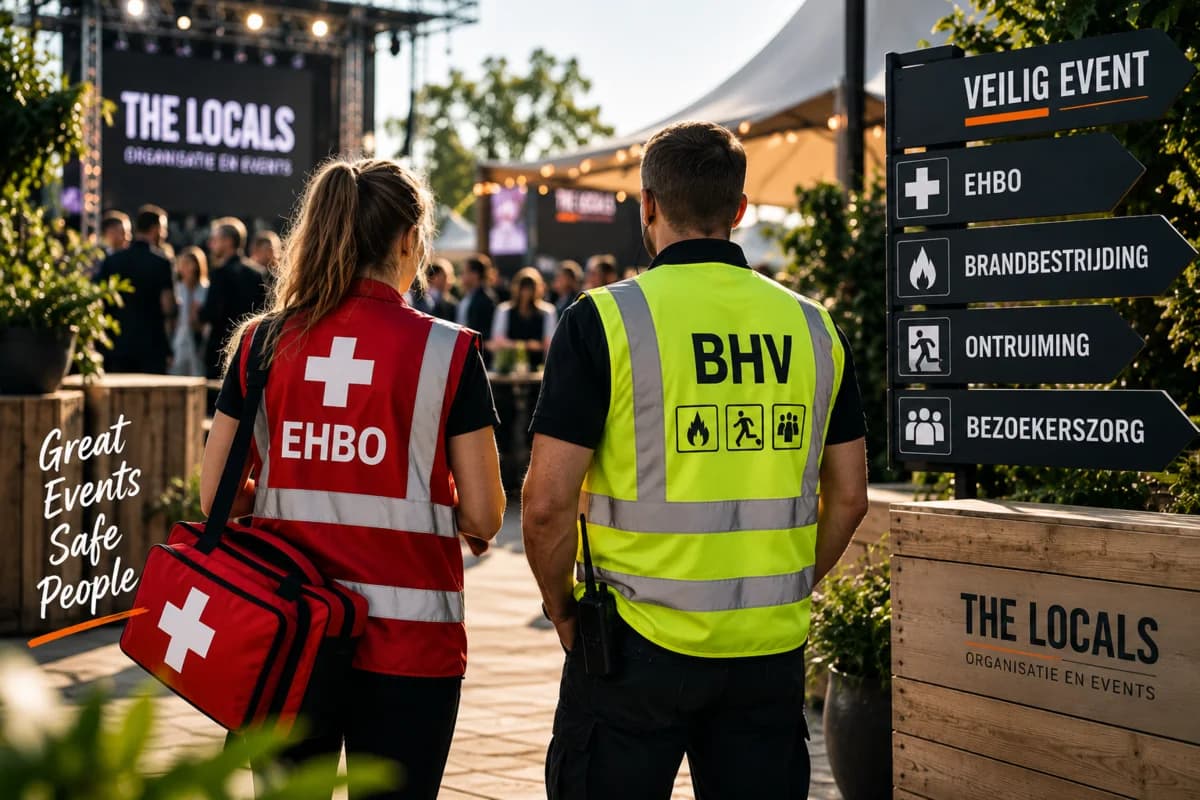
A logical question. Because a first aider and an emergency response officer can both provide first aid. Yet they have a different role and are not simply interchangeable. When do you deploy who? And when might you need both? We explain.
What is the difference between first aid (EHBO) and in-house emergency response (BHV)?
Very briefly:
A first aider focuses primarily on providing first aid to people who are injured or become unwell.
An in-house emergency response officer has a broader task within workplace safety and is there for, among other things, first aid, firefighting, raising the alarm and evacuating.
And that is exactly where the most important difference lies. So at an event the two disciplines have a different function.
What does a first aider do at an event?
EHBO is the Dutch abbreviation for first aid in the event of accidents.
A first aider who is deployed specifically for event care is present to help visitors, staff or participants who need care.
Think of:
- a wound or a fall;
- fainting;
- bruises;
- burns;
- overheating;
- allergic reactions;
- or someone who suddenly becomes unwell.
At many events, first aid forms the basis of the event care on site. For low-risk events, Basic First Aid may be sufficient. At larger events or events with a higher risk profile, additional event care may be needed. And at events with specific or greater medical risks, professional care providers can be deployed alongside first aiders.
And what does an emergency response officer do?
BHV is the Dutch abbreviation for in-house emergency response.
Under the Dutch Working Conditions Act (Arbowet), every employer must organise in-house emergency response and appoint one or more emergency response officers. How many officers are needed and how the emergency response is set up depends on the size and risks of the organisation as they emerge from the risk inventory and evaluation (RI&E). An emergency response officer is trained to act quickly in an emergency.
Think of:
- providing first aid;
- fighting or containing fire;
- alerting people;
- helping to evacuate a building or site;
- receiving and supporting the emergency services.
So an emergency response officer looks at an emergency more broadly than just at the casualty. Suppose a fire breaks out during a corporate event. Then it is not only about any injured people, but also about alerting those present, evacuating the building or site and calling in the professional emergency services. That is typically the domain of in-house emergency response.
So can an emergency response officer simply do the first aid as well?
This is where confusion often arises. An emergency response officer learns to provide first aid, but that does not automatically mean that someone has the qualifications and competences required of a first aider within event care.
For Basic First Aid at events, the Dutch field standard for event care (Veldnorm Evenementenzorg) assumes a valid First Aid diploma or certificate that complies with the Dutch First Aid Guidelines. For the Event First Aid level, additional competences are needed. So if you need event care for your event, simply saying: "No problem, Piet from accounts is an emergency response officer." is not automatically enough.
The same applies the other way round. A first aider who is present specifically for medical assistance is not automatically the person responsible for, say, an evacuation or the start of a fire. First aid and in-house emergency response can complement each other, but have a different role.
When do you deploy first aid at an event?
Which event care is needed must fit the risk profile of the event.
Among other things, the following are considered:
- nature of the event;
- number of visitors;
- activities;
- age and composition of the audience;
- expected health risks;
- site and accessibility;
- distance and response time of ambulance care;
- and possible special risks.
At a small-scale business gathering, for example, the risks are very different from those at a large festival, sports event or dance event. For low-risk events without aggravating factors, Basic First Aid may be sufficient. With higher risks, other levels of care and care professionals may be needed.
When do you need in-house emergency response?
In-house emergency response comes from a different responsibility. An employer must make sure adequate emergency response is arranged within its organisation. The organisation and capacity needed follow from the risks and the RI&E. Are you organising a staff event at your own business premises, for example? Then the existing emergency response organisation does not suddenly cease to exist because a party is being organised.
What is more: the event can temporarily bring completely different risks. An industrial hall where 40 people normally work can suddenly be filled during a staff party with hundreds of guests, scenery, catering, stages, temporary power supplies and entertainment. Then it is sensible to look at the safety situation again.
When do you need first aid and in-house emergency response?
That question comes up regularly. Take a large staff festival on a company's premises.
The first aid/event care focuses on visitors who need medical help. The emergency response organisation focuses, among other things, on incidents and emergencies around the business environment, fire and evacuation.
In addition, security guards, traffic marshals and professional emergency services may be involved. Everyone has their own role. But ultimately all those parties must be able to function as one safety organisation. And at large events that is perhaps the most important point.
Who does what when something really happens?
A vest and a two-way radio do not make a safety plan. It must be clear in advance:
- Who is in charge in an emergency?
- Who calls 112?
- Who receives the ambulance or fire brigade?
- Who opens an emergency route?
- Who starts an evacuation?
- Where is the first-aid post?
- Who communicates with visitors?
- And how do first aid, emergency response, security, the organisation and the venue communicate with each other?
Those are questions you would rather answer during the preparation than when something actually happens.
What does the event permit say?
For events that require a permit, the municipality can also set requirements for the event care and safety organisation needed. Municipalities and the GHOR (the regional medical assistance organisation) use the risk profile of the event to assess which care is appropriate. The Veldnorm Evenementenzorg is widely applied as a framework for this. That is why at The Locals we never look only at: "How many first aiders do we need to book?"
We look at the whole safety picture. What are we organising? Where? For how many people? What risks are there? What does the venue require? What does the permit say? And how do we make sure all the parties involved know what they have to do?
First aid, emergency response or both?
If you remember one thing from this article, let it be this: first aid (EHBO) and in-house emergency response (BHV) are not two different names for the same thing. Within an event, first aid focuses primarily on care for people. In-house emergency response focuses more broadly, from the organisation's side, on acting in incidents and emergencies, including first aid, fire and evacuation. What you need depends on the event. Sometimes a limited first-aid provision is enough. Sometimes you need first aid and an emergency response organisation. And at events with a higher risk profile, professional medical care providers may be needed too.
Safety is made to measure.
Being well prepared mostly means organising with peace of mind
Safety may not be the first thing you think of when you come up with a great staff party or congress. And actually that is fine. As a guest you should hardly notice any of it. But behind the scenes it has to be right. From permits, insurance and safety plans to first aid, emergency response, security, escape routes and emergency routes. So that when the doors open, everyone can focus on what the event is meant for: a great experience.
An event coming up?
The Locals organises and produces corporate events from the first idea to the final breakdown. In doing so we look not only at concept, venue, technology and entertainment, but also at everything needed to organise an event professionally and safely.
Organisation and events. The Locals makes it happen.
Do you have plans for a staff event, congress, open day or other corporate event? Get in touch with us. We are happy to think along with you.
This article was written on 4 September 2026. Regulations may change; always ask us about the current regulations.